English
 Español
Robotic Deburring vs. Grinding vs. Polishing: Which Process Does Your Part Need?
Manufacturers often use the terms deburring, grinding and polishing as if they describe the same operation. In practice, they solve different manufacturing problems.
Deburring focuses on removing burrs, flash and sharp edges. Grinding removes more material to correct shape, eliminate weld seams or reduce casting defects. Polishing refines the surface after major defects have been removed.
The same robot or abrasive station may sometimes perform more than one of these operations, but the process objective, tooling, contact conditions and quality criteria are not the same. Understanding robotic deburring vs. grinding vs. polishing is therefore the first step toward specifying the right automation system.
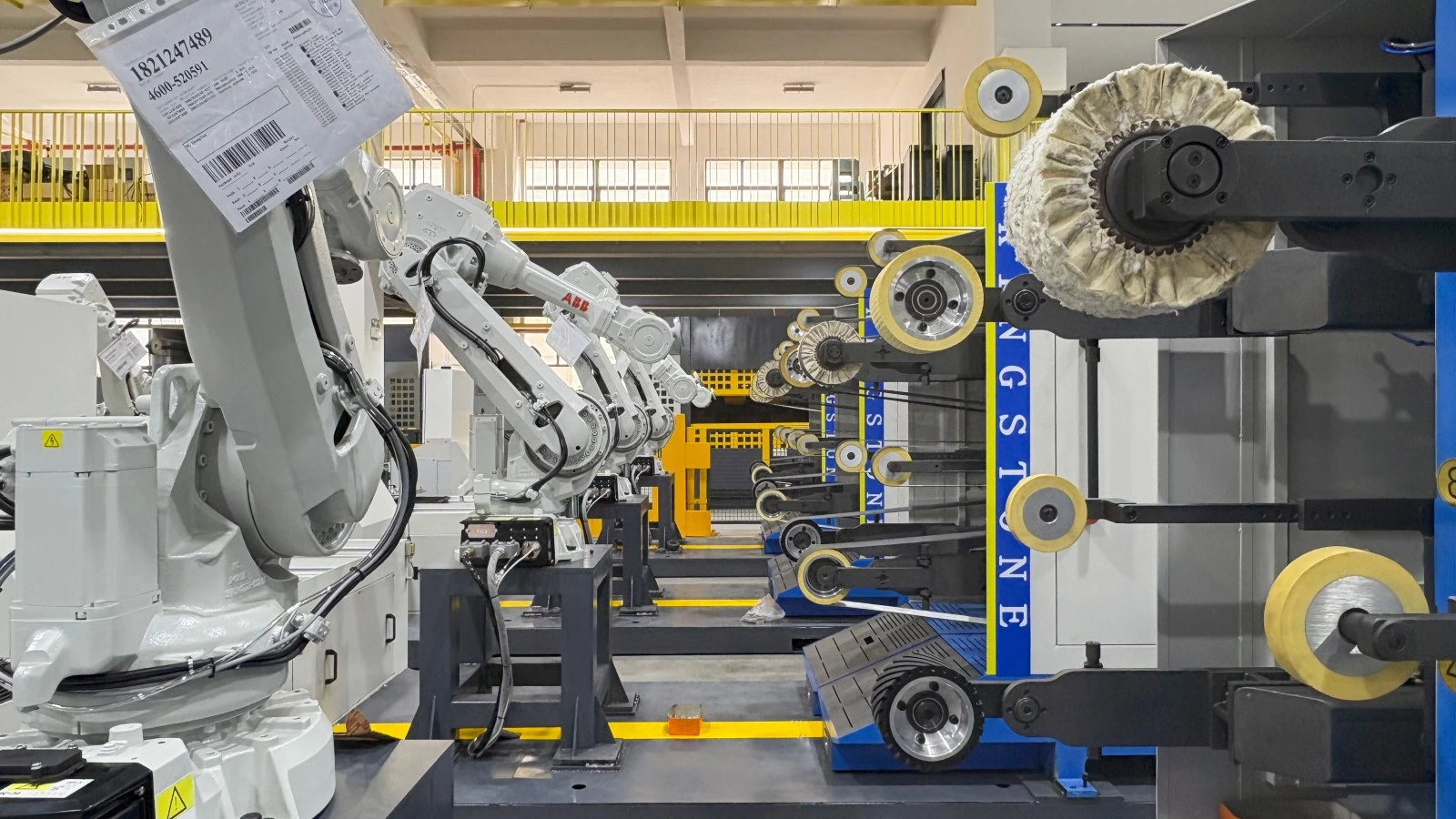
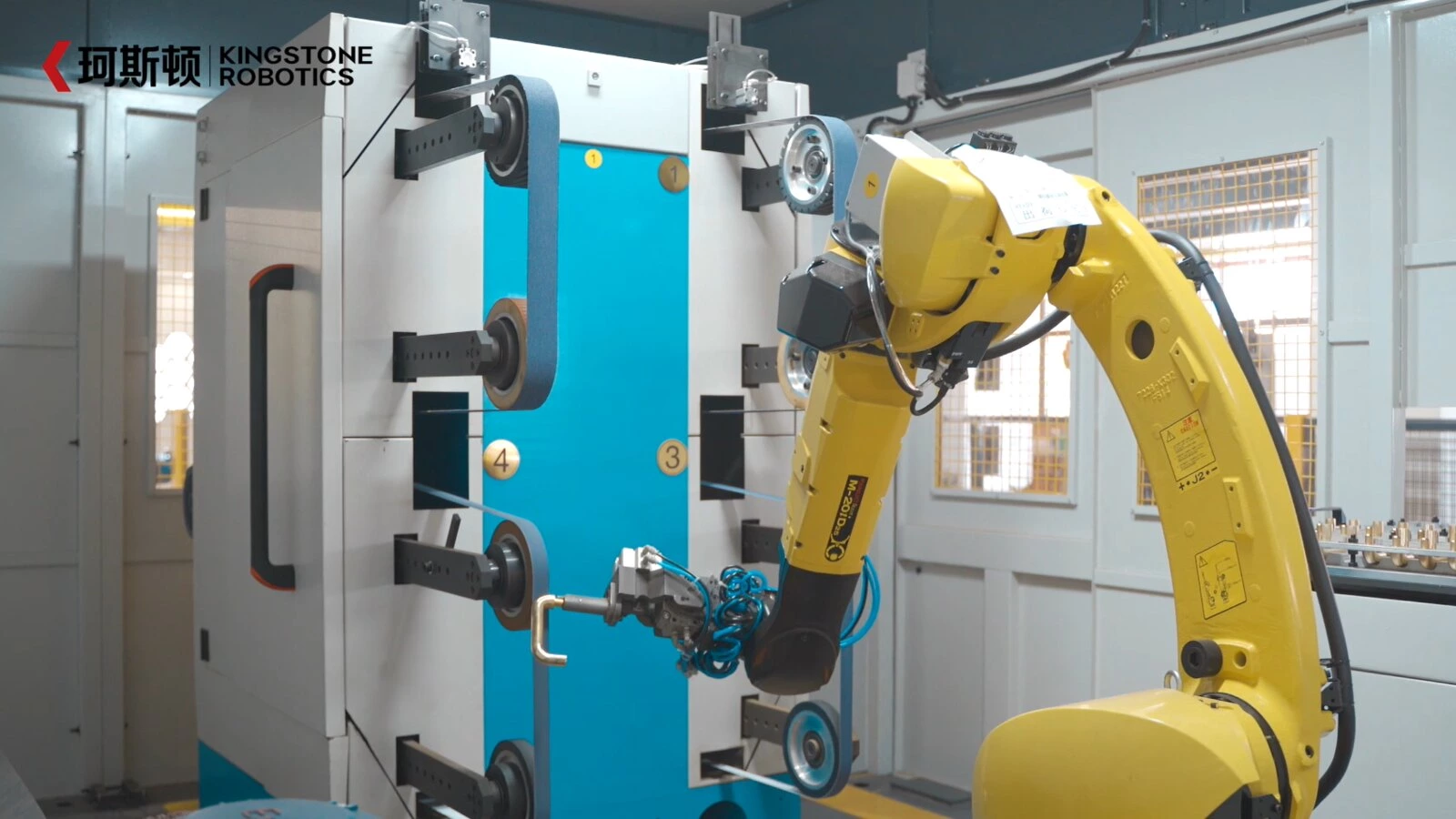
See a Kingstone robotic surface-finishing cell in action. The guide below explains how deburring, grinding and polishing differ and how to choose the right process for your parts.
Robotic Deburring, Grinding and Polishing at a Glance
| Process | Main Purpose | Common Targets | Expected Result |
|---|---|---|---|
| Deburring | Remove unwanted projections and sharp edges | Machining burrs, drilled-hole burrs, casting flash and sharp edges | Clean, safe and controlled edges |
| Grinding | Remove material and correct geometry | Gates, risers, weld seams, parting lines, high spots and deep defects | Corrected shape and an even intermediate surface |
| Polishing | Refine surface texture and appearance | Grinding scratches, uneven texture and visible surface marks | Smoother, more uniform or decorative finish |
The process should be defined by the required result rather than by the tool name alone. For example, an abrasive belt may be used for heavy grinding in one application and finer surface refinement in another.
What Is Robotic Deburring?
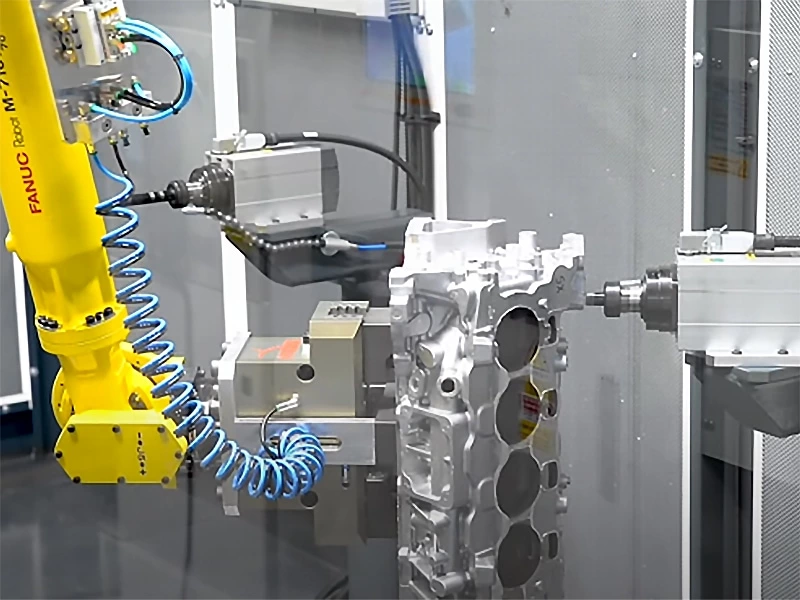
Robotic deburring removes unwanted material formed along an edge, hole or parting line during machining, drilling, cutting, stamping, casting or forging.
A burr is normally a raised or deformed edge left by a manufacturing operation. Flash is excess material that may form along the parting line of a casting or forging. Thin flash may be handled as a deburring operation, while heavy casting gates or large projections usually require cutting or grinding before final edge finishing.
Typical robotic deburring tools include:
-
Rotary carbide tools
-
Abrasive brushes
-
Flap wheels
-
Abrasive wheels
-
Belt-based edge-finishing stations
-
Application-specific compliant tools
The quality target is usually not a highly polished surface. Instead, the objective may include removing loose burrs, eliminating sharp edges, producing a specified edge radius or chamfer, and protecting nearby sealing, threaded or mating surfaces.
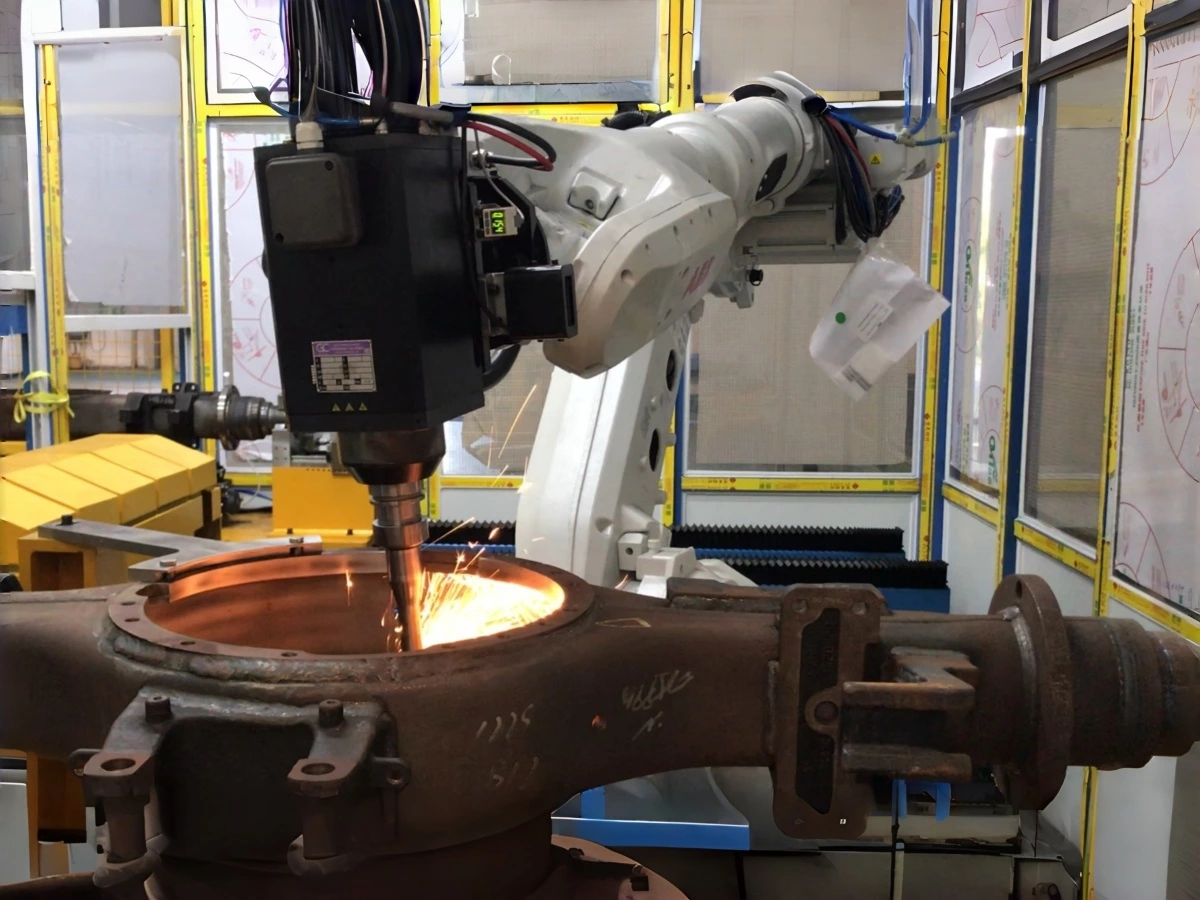
A dedicated robotic deburring unit is suitable when burr removal and edge consistency are the primary requirements, especially for cast housings, automotive components, machined parts and components with repeated holes or complex contours.
What Is Robotic Grinding?
Robotic grinding is primarily a material-removal and shape-correction process. It is normally more aggressive than polishing and may also remove significantly more material than fine deburring.
Common grinding tasks include:
-
Removing casting gates and riser remnants
-
Grinding parting lines and heavy flash
-
Reducing weld beads
-
Correcting high spots or uneven contours
-
Removing scale and deep surface defects
-
Blending transitions between joined surfaces
-
Preparing a part for a finer finishing stage
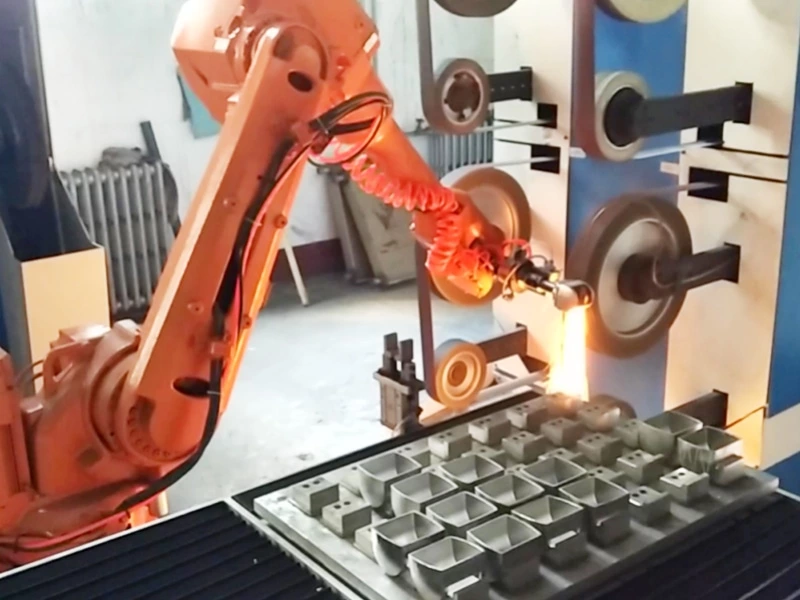
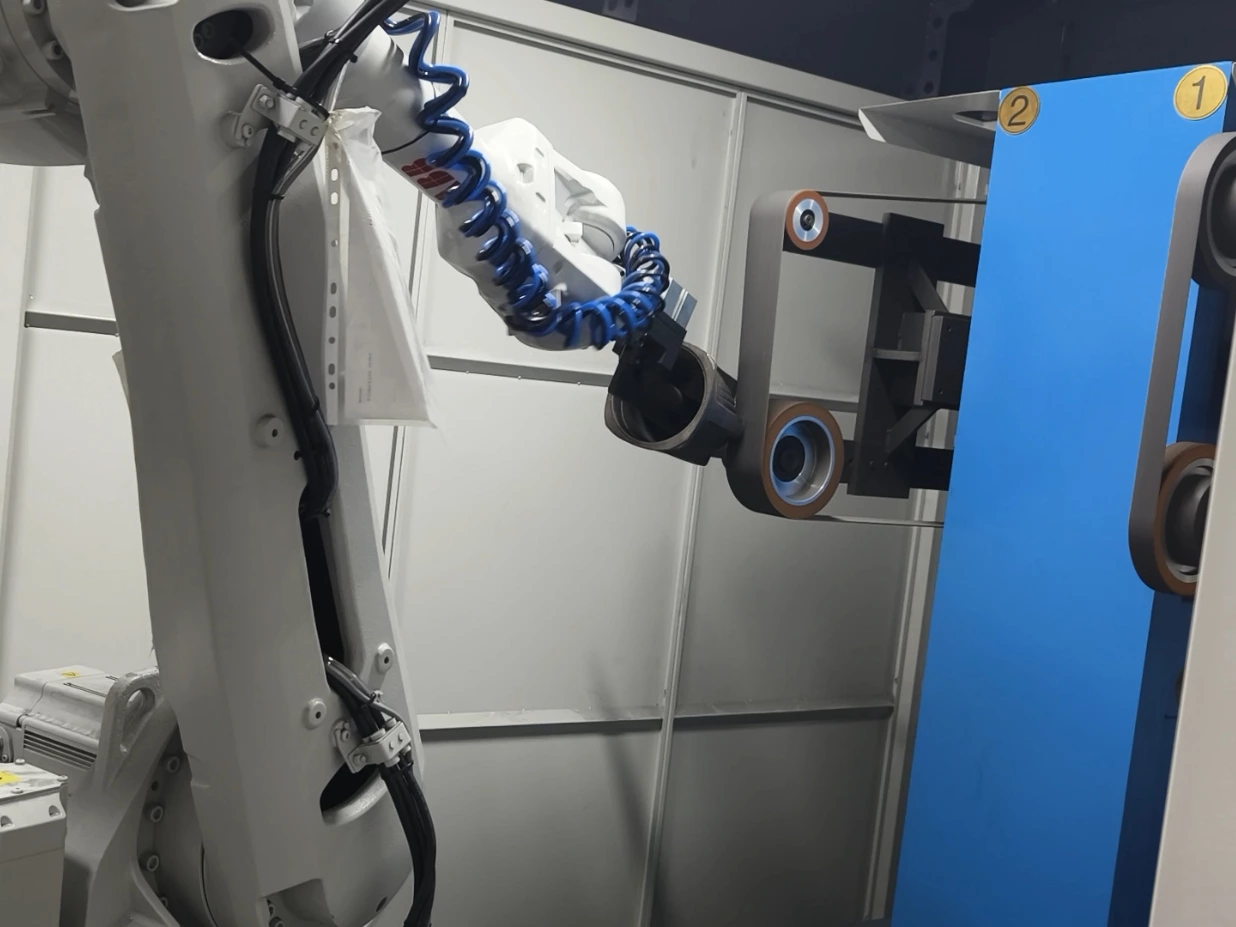
A robotic grinding unit may use abrasive belts, grinding wheels, flap wheels, discs or rotary tools, depending on the material, defect size and required geometry.
Grinding quality should be evaluated by how much unwanted material has been removed and whether the required contour has been maintained. Excessive grinding can create gouges, overheating, distortion or dimensional changes. Stable contact conditions and controlled material removal are therefore essential.
Grinding does not automatically create a decorative final finish. A correctly ground surface may still show an abrasive scratch pattern and require further polishing.
What Is Robotic Polishing?
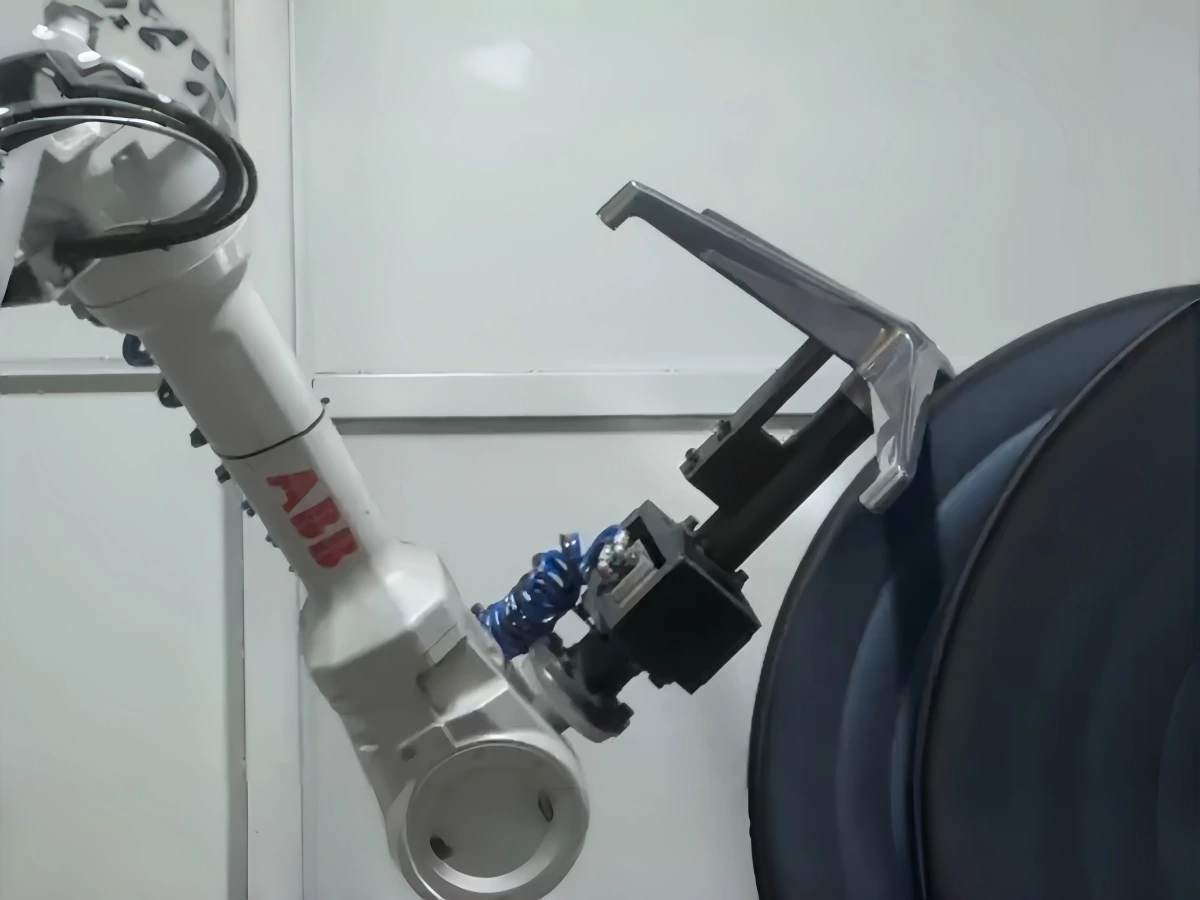
Robotic polishing refines a surface after major geometric defects and excess material have been removed. The process generally uses finer abrasives to reduce scratch depth, blend surface transitions and create a more uniform finish.
Polishing may be required to:
-
Smooth scratches left by grinding
-
Improve surface roughness
-
Produce a consistent directional finish
-
Prepare a surface for coating or plating
-
Improve the appearance of visible components
-
Create a uniform finish across curved or complex surfaces
A robotic grinding and polishing system can use several abrasive stages, moving from a coarser abrasive to progressively finer tools. The correct sequence depends on the starting condition, material and final surface requirement.
Polishing and buffing should also be distinguished. Polishing normally uses abrasives to refine the surface. Buffing is often a later finishing step that uses cloth or sisal wheels with polishing compound to increase gloss and remove very fine surface haze. A high-gloss or mirror-like result may therefore require grinding, progressive polishing and final buffing rather than a single operation.
Which Process Does Your Part Need?
Begin with the defect or result you need to control.
Choose deburring when the main problem is:
-
Sharp edges
-
Machining burrs
-
Burrs around drilled holes
-
Thin casting flash
-
Unsafe or inconsistent edge conditions
Choose grinding when the part has:
-
Excess material that requires significant removal
-
Weld seams or weld beads
-
Casting gates or heavy parting lines
-
High spots or shape deviations
-
Deep scratches or surface defects
Choose polishing when the goal is:
-
A smoother surface
-
A more uniform scratch pattern
-
Improved surface roughness
-
Preparation for coating or plating
-
A decorative or visually consistent finish
If the final requirement is a high-gloss surface, polishing may need to be followed by buffing.
Why One Part May Require Several Processes
Many industrial parts cannot reach their final condition through one process alone.
Cast Aluminum Housing
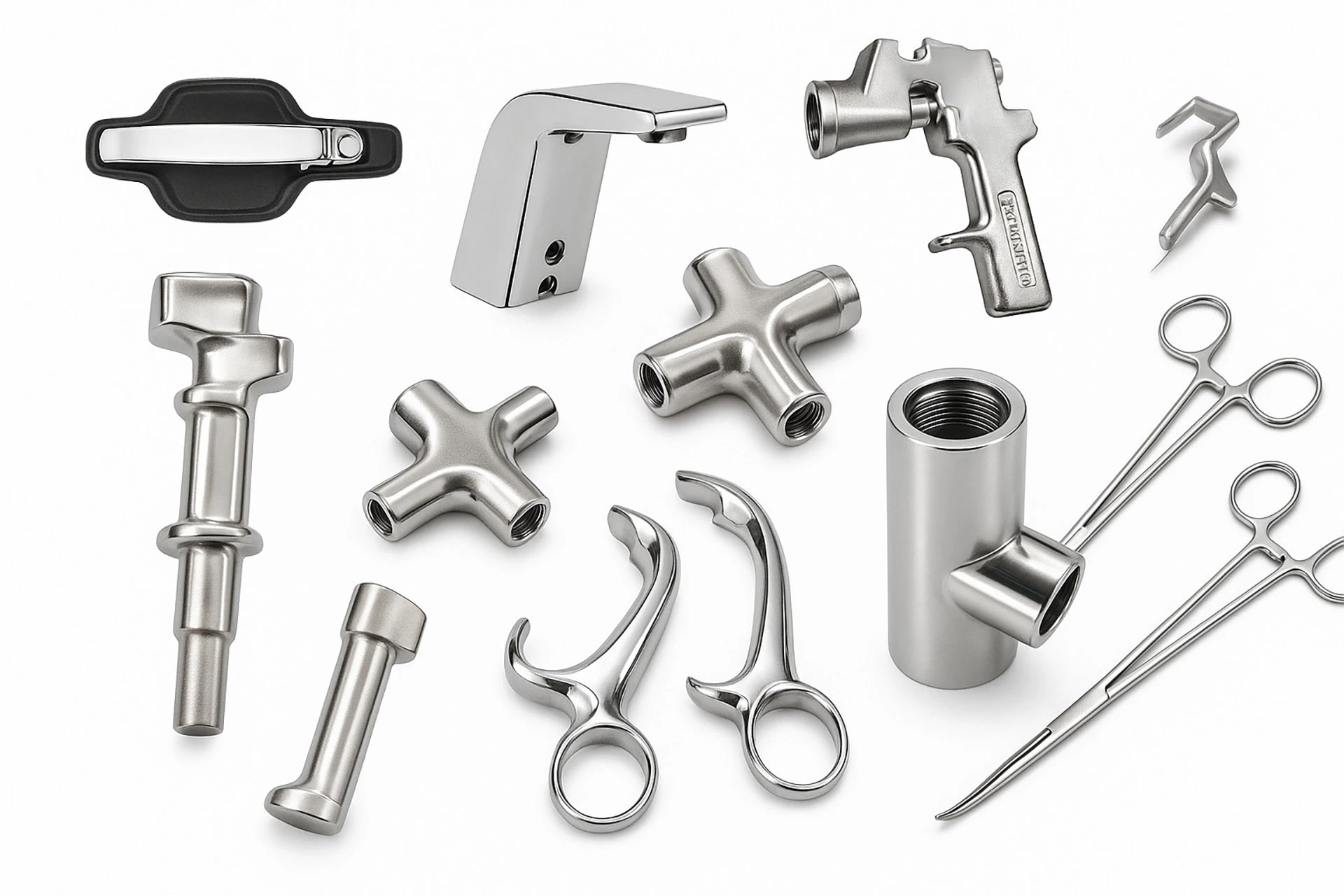
After trimming, the remaining gate or heavy parting line may require grinding. Holes and edges may then need targeted deburring. If the housing has visible surfaces or will receive a decorative coating, selected areas may also require polishing.
Brass or Stainless Steel Faucet
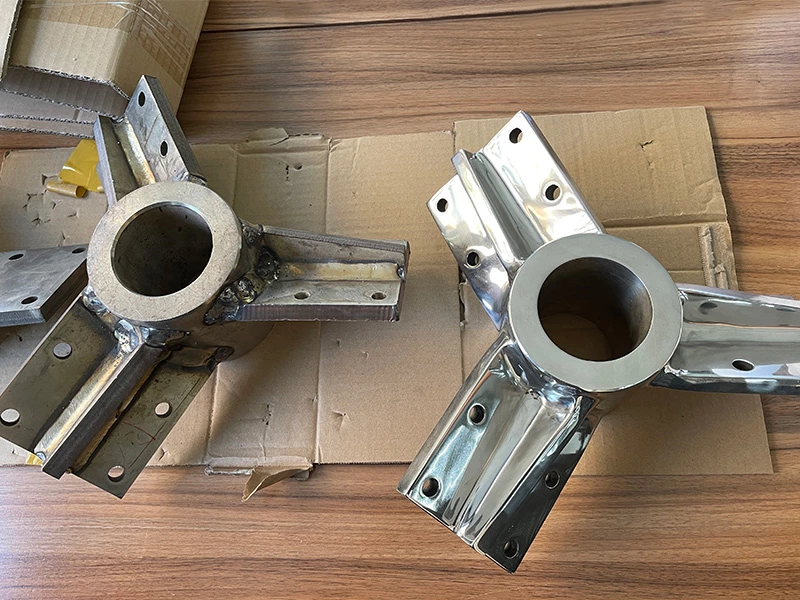
Casting lines and major defects are first removed by grinding. Progressive polishing then reduces the grinding marks. If a bright decorative finish is required, a final buffing operation may be added before plating.
CNC-Machined Aluminum Component
The part may only need controlled deburring around machined edges and holes. Light polishing or abrasive blending can be added when a more uniform appearance is required. Heavy grinding is unnecessary if the dimensions and surface geometry are already correct.
Welded Automotive Component
The weld seam may first be ground to the required profile. The transition area can then be polished if the component requires a smooth visible surface or consistent preparation before coating.
The exact order is not universal. It should be confirmed through sample testing because the starting condition and acceptance criteria differ from one part to another.
Seven Questions to Ask Before Selecting the Process
1. What exactly needs to be removed?
Identify whether the problem is a burr, flash, weld bead, gate, scratch, high spot or uneven surface texture. Clear defect photographs are useful at this stage.
2. What must the finished part look like?
Specify whether the target is simply a burr-free edge, a defined radius, a particular surface roughness, a directional finish, a plating-ready surface or a high-gloss appearance.
3. How much material can be removed?
Functional surfaces, sealing areas, thin walls and precision features may have strict material-removal limits. These limits affect the tooling and force-control strategy.
4. What material is being processed?
Aluminum, brass, stainless steel, cast iron, zinc alloys and engineering plastics respond differently to abrasives, pressure and heat. The abrasive type and process parameters must match the material.
5. Can the tool reach every required area?
External surfaces, internal corners, cross holes and narrow channels may require different tools or robot orientations. Tool access should be evaluated from drawings, 3D models or physical samples.
6. What is the production volume and product mix?
High-volume production may justify dedicated stations and automated loading. High-mix production may require quick-change fixtures, stored process recipes and more flexible tooling.
7. What happens after surface finishing?
Parts that will be plated, coated, welded or assembled may need different surface and edge conditions. The downstream operation should be considered before the robotic process is finalized.
Choosing the Robotic Cell Configuration
There are two common processing arrangements.
In a part-to-tool system, the robot grips the workpiece and presents it to fixed grinding, polishing or buffing stations. This arrangement is often suitable for small and medium-sized parts that must be rotated through several orientations.
In a tool-to-part system, the workpiece remains in a fixture or on a production line while the robot carries the processing tool. This arrangement is commonly considered for large, heavy or difficult-to-handle components.
Hybrid systems are also possible. The correct configuration depends on part weight, geometry, tool access, cycle time and the number of required processes.
Can One Robotic Cell Perform All Three Processes?
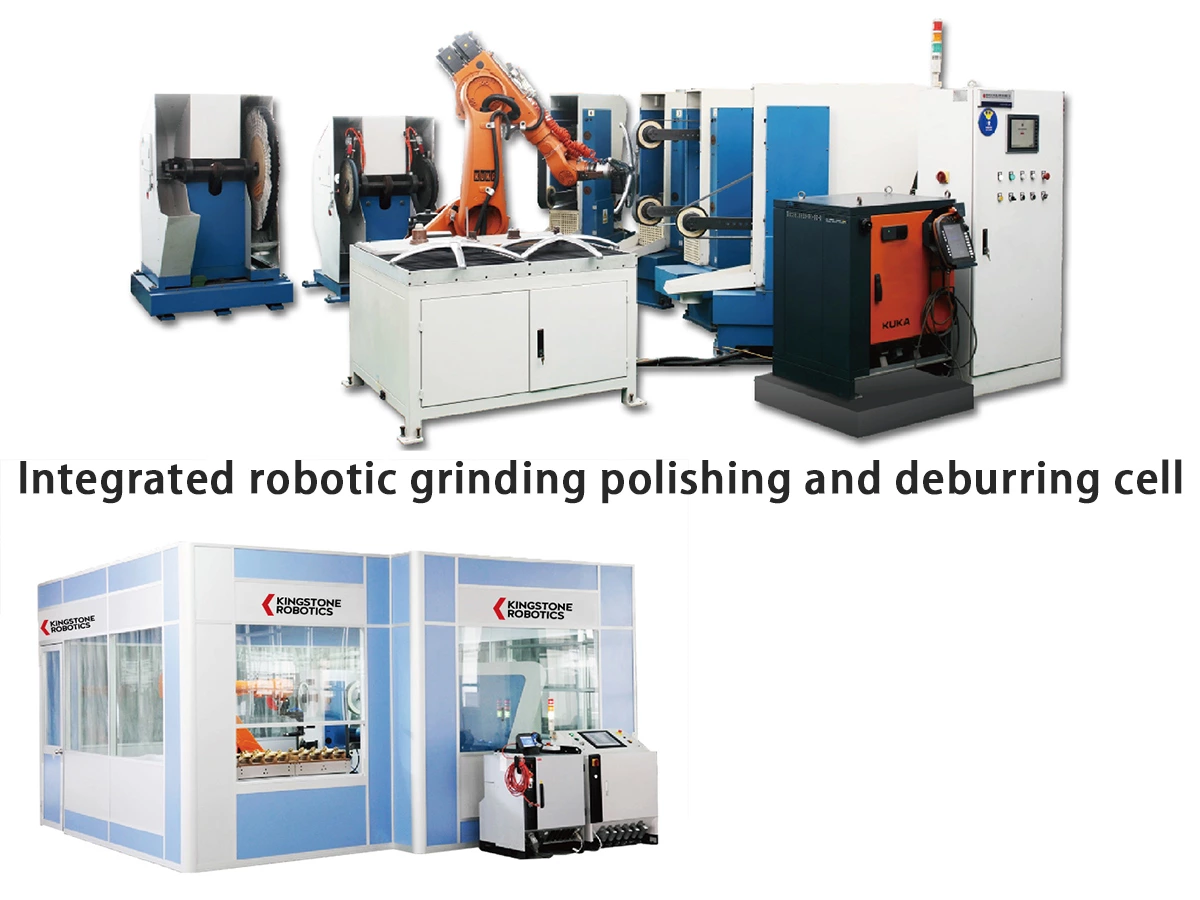
Yes, an integrated multi-process robotic cell can perform deburring, grinding and polishing when the application has been designed for that sequence. The cell may use multiple fixed tool stations, robot-carried tools, tool-changing equipment or a combination of these methods.
However, combining every process is not automatically the best choice. A dedicated deburring cell may be more efficient when deburring is the only required operation. A multi-process cell becomes more valuable when the same part repeatedly requires several finishing stages and unnecessary handling between separate machines can be avoided.
Regardless of the configuration, a reliable system must control:
-
Workpiece positioning and fixture repeatability
-
Contact force and process compliance
-
Robot path, speed and tool orientation
-
Abrasive selection and process sequence
-
Tool wear and replacement timing
-
Dust, chips, noise and operator safety
Fixture design affects whether the workpiece remains stable and accessible during processing. Abrasive wear and contact-force control also affect whether the first and last parts in a production batch receive a consistent result.
Information to Provide for a Robotic Process Evaluation
Before requesting a solution, prepare as much of the following information as possible:
-
Part drawings or 3D files
-
Material, dimensions and weight
-
Photographs showing the burrs or surface defects
-
Photographs or samples of the required final finish
-
Current manual processing steps
-
Current processing time per part
-
Required output per shift or per day
-
Acceptable dimensional and surface tolerances
-
Product varieties and changeover frequency
-
Downstream coating, plating or assembly requirements
-
Available factory space and preferred loading method
A sample trial is normally the most reliable way to confirm the tool, abrasive sequence, robot path and expected cycle time.
Frequently Asked Questions
Is deburring the same as grinding?
No. Deburring targets unwanted material along edges, holes and parting lines. Grinding generally removes more material and is used for shape correction, heavy defects, gates or weld seams. Some tools can perform both operations, but the objectives and acceptance criteria remain different.
Can polishing remove burrs?
Very small projections may sometimes be reduced during surface finishing, but polishing should not replace a controlled deburring process when edge quality is specified. Attempting to polish away a large burr may damage the surrounding surface or round an edge excessively.
Does polishing always produce a mirror finish?
No. Polishing can produce different levels of smoothness and appearance. A mirror-like result usually requires several abrasive stages and may also require final buffing with the appropriate wheel and compound.
Can the same robot process different materials?
A robot cell may be configured for different materials, but the abrasives, force, speed, fixtures and process recipes may need to change. Feasibility should be confirmed for each part family.
What is the best way to determine the required process?
Provide the part drawing, material, defect photographs, current process and required final result. Physical sample testing can then determine whether the part needs deburring, grinding, polishing, buffing or a combination of processes.
Select the Process Before Selecting the Machine
The right automation solution begins with a clear understanding of the workpiece problem. Deburring controls edges, grinding corrects shape and removes heavier defects, while polishing refines the surface. Treating them as separate processes makes it easier to select suitable tooling, define realistic quality standards and design an efficient robotic cell.
Kingstone Robotics develops turnkey automation for surface finishing based on each customer’s parts, materials, production targets and required finish. Contact our engineering team and send your drawings or sample photographs for an application evaluation.